Selecting plants that evolved in the same region as a backyard is the most reliable approach to reducing maintenance over the long term. Native species have developed root structures, dormancy cycles, and pest tolerances suited to local soils and climate — no supplemental fertilizer, minimal irrigation after establishment, and no seasonal guesswork about winter hardiness.
Canada spans multiple plant hardiness zones and distinct ecological regions, from the coastal rainforests of British Columbia to the boreal edge in northern Ontario and the Carolinian woodlands of southwestern Ontario. This variation means there is no single plant list that applies everywhere — but there are well-documented species for each region with enough flexibility to work across a range of backyard conditions.

Groundcovers and Low Perennials
Groundcovers perform two functions in a low-maintenance backyard: they fill space that would otherwise require mowing or weeding, and they prevent soil erosion on slopes or under tree canopies where lawn grass struggles.
Bunchberry (Cornus canadensis)
One of the most widely distributed native groundcovers in Canada, bunchberry grows across boreal and coastal regions from British Columbia to Newfoundland. It reaches 10–20 cm in height, produces white flower bracts in late spring, and sets clusters of bright red berries by late summer. Bunchberry performs best in partially shaded, consistently moist, acidic soils — the kind found under conifers or in woodland gardens. It spreads slowly by rhizome but does not become invasive in garden settings.
Wild Ginger (Asarum canadense)
Wild ginger spreads gradually to form dense, weed-suppressing mats in shaded locations. The heart-shaped leaves are distinctive and stay green well into autumn. It grows in the understory of eastern Canadian deciduous forests — particularly in Ontario and Quebec — where it tolerates heavy shade and competes effectively with invasive garlic mustard when established at sufficient density. The plant is not related to culinary ginger and should not be consumed.
Perennials
Native perennials offer recurring seasonal interest without replanting. Most require only division every few years to maintain vigour.
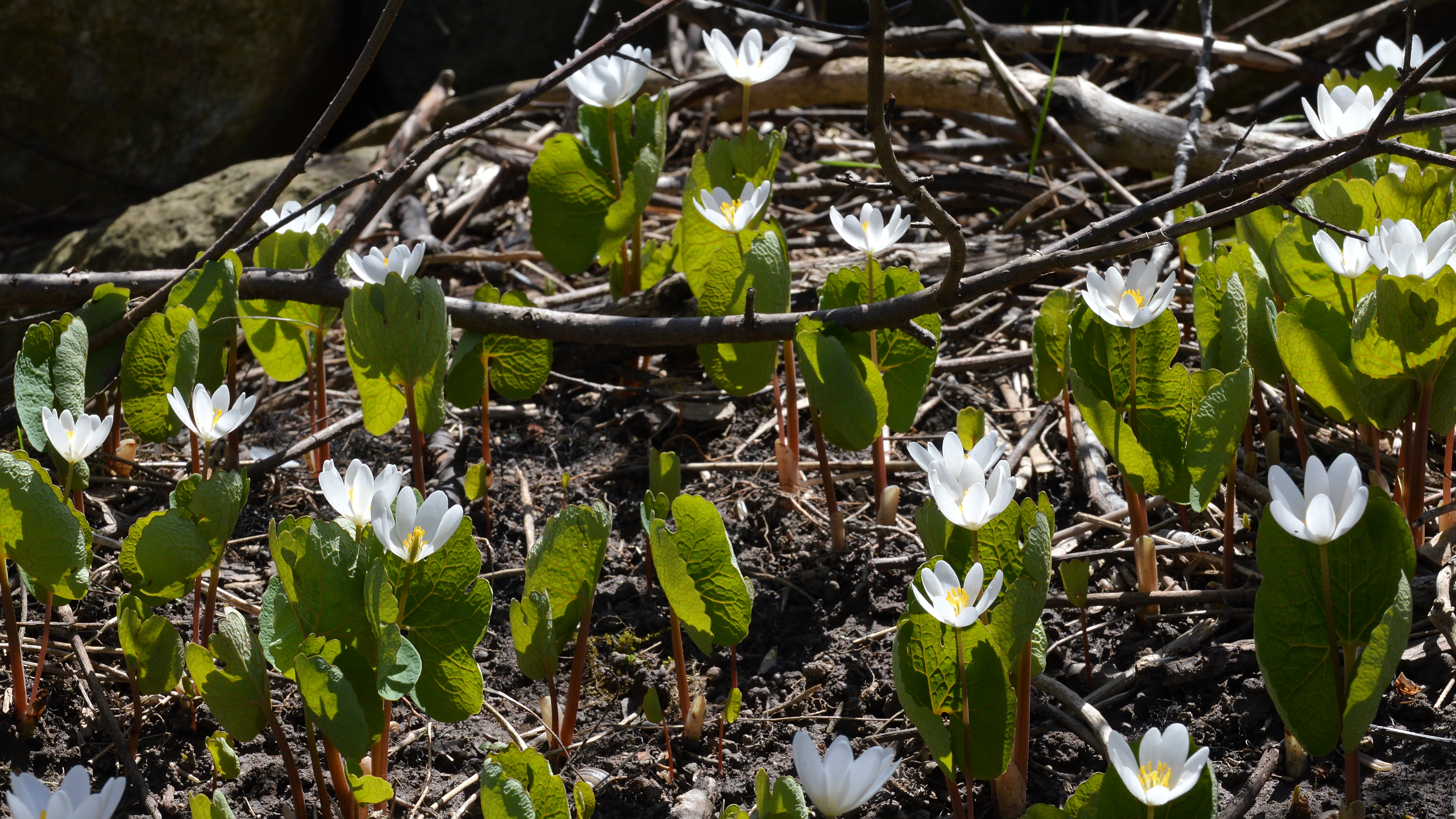
Bloodroot (Sanguinaria canadensis)
Bloodroot emerges in early spring — often while snow is still receding — with white flowers that last only a few days. The large, lobed leaves persist through summer before dying back naturally. It grows in rich, well-drained woodland soils in Ontario and Quebec, tolerating partial to full shade. The plant's orange-red sap is distinctive; contact with eyes or mucous membranes should be avoided.
Swamp Milkweed (Asclepias incarnata)
Swamp milkweed is a mid-height perennial (60–120 cm) suited to moist garden borders, rain gardens, and areas that retain water after heavy rain. It produces clusters of deep pink flowers in mid-summer and is the primary larval host plant for monarch butterflies in Ontario and Manitoba. Unlike common milkweed (Asclepias syriaca), swamp milkweed does not spread aggressively by root runners, making it easier to manage in a residential context. It self-seeds moderately; seedheads can be cut before they open if spreading is a concern.
Purple Coneflower (Echinacea purpurea)
Though its native range in Canada sits primarily at the Carolinian fringe of southwestern Ontario, purple coneflower is broadly adaptable and reliably hardy to Zone 3 when grown in well-drained soils. It flowers from July through September, attracting a wide range of native bees, and the dried seedheads feed finches and other small birds through winter. The plant tolerates drought once established and does not require division for many years.
Shrubs
Native shrubs add structure and canopy to backyard designs without requiring the pruning schedule of ornamental hedges. Many provide seasonal food for birds.
Nannyberry (Viburnum lentago)
Nannyberry is a multi-stem shrub or small tree reaching 3–5 m in height. It is native to eastern Canada and tolerates a broader range of soil conditions than most viburnums — including periodically wet sites. White flower clusters appear in late spring, followed by blue-black berries that are consumed by birds before frost. It can be used as an informal screen or planted in groups at the back of a border. Nannyberry does not require deadheading and needs minimal pruning once established.

Buttonbush (Cephalanthus occidentalis)
Buttonbush is one of the few native shrubs that thrives in consistently saturated soils — making it useful for low-lying areas that collect water and drain slowly. It grows 1–3 m tall and produces unusual spherical white flower clusters in July and August that are heavily visited by native bees and hummingbirds. In Canada, its natural range is concentrated in southern Ontario.
Small Trees
Showy Mountain-Ash (Sorbus decora)
Showy Mountain-Ash is a small deciduous tree (up to 10 m) native to Ontario, Quebec, and Atlantic Canada. It produces clusters of white flowers in late spring and vivid orange-red berry clusters in late summer and autumn. The berries persist well into winter and attract waxwings, robins, and other migratory species. It is hardy to Zone 3 and performs well in open, sunny positions with well-drained to moist soils. The tree is not particularly drought-tolerant in its first two growing seasons and benefits from supplemental watering during establishment.
Regional Planting Notes
Note on hardiness zones: Natural Resources Canada publishes the Plant Hardiness Zone Map (available at planthardiness.gc.ca), which divides Canada into eight primary zones based on minimum winter temperatures. Species native to a given zone are generally reliable choices for backyards in that zone or warmer.
- British Columbia coast: Western red cedar (Thuja plicata), red-flowering currant (Ribes sanguineum), and sword fern (Polystichum munitum) are among the most widely grown native species for shaded and semi-shaded gardens.
- Prairie provinces: Big bluestem (Andropogon gerardii), prairie crocus (Pulsatilla patens), and saskatoon (Amelanchier alnifolia) are well-documented choices for open, often alkaline soils.
- Ontario and Quebec: The Carolinian and mixed forest zones support a wider diversity of native plants than most Canadian regions. Joe-pye weed (Eutrochium maculatum), wild bergamot (Monarda fistulosa), and woodland aster (Symphyotrichum cordifolium) are reliable perennials.
- Atlantic Canada: Rhodora (Rhododendron canadense), bunchberry, and sheep laurel (Kalmia angustifolia) are adapted to the acidic, sandy soils common in Nova Scotia and New Brunswick.
Sourcing Native Plants
Many retail garden centres stock species labelled as native but grown from non-local seed stock. Plants propagated from seed sources within the same ecological region — known as locally sourced ecotypes — are better adapted to local conditions than the same species grown from distant seed. When local sourcing matters, native plant nurseries associated with conservation authorities or provincial programs are more reliable than general garden retailers.
The Canadian Wildlife Federation maintains a Native Plant Encyclopedia at cwf-fcf.org with species profiles and a search function by region. The David Suzuki Foundation has also published planting guides for several major Canadian cities.
Information on this page draws from publicly available sources including Natural Resources Canada, the Canadian Wildlife Federation, and peer-reviewed plant ecology literature. Species descriptions reflect documented characteristics under typical garden conditions; individual outcomes depend on specific site conditions, soil type, and climate variability. Last reviewed June 2026.

